


AI Overview
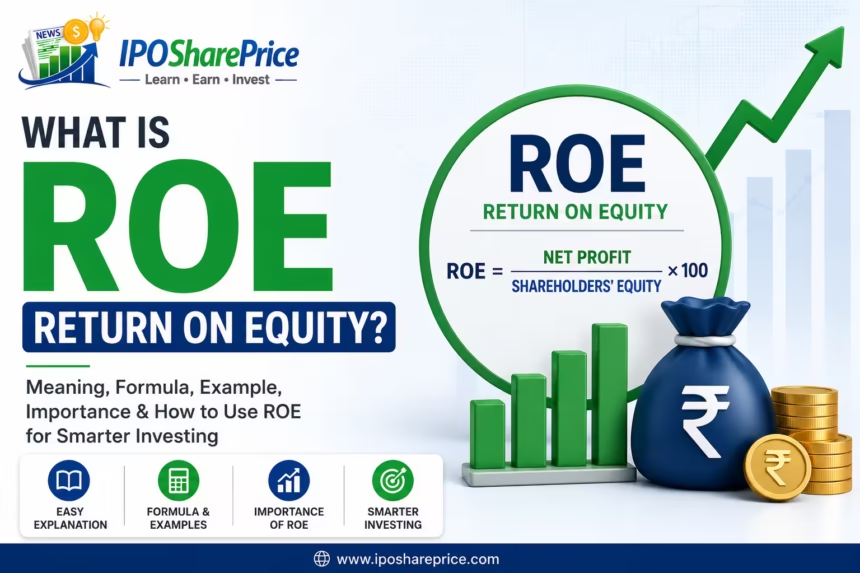
What is ROE? ROE (Return on Equity) measures how efficiently a company uses shareholders’ money to generate profit. Formula: ROE = Net Profit ÷ Shareholders’ Equity × 100. A ROE of 20% means the company earns ₹20 of profit for every ₹100 of equity invested by shareholders. Higher ROE generally indicates a more efficient, profitable business. For Indian companies, ROE above 15–20% is considered good, above 25% is excellent.
Introduction: The Metric That Separates Good Businesses From Great Ones
You can find hundreds of profitable companies in the Indian stock market. But profitability alone does not tell you how efficiently a company is using the capital its shareholders have entrusted to it.
Return on Equity (ROE) is the metric that answers this question. It is one of the most important ratios in fundamental analysis used by Rakesh Jhunjhunwala, Warren Buffett, and most serious long-term investors as a primary filter for identifying quality businesses.
What Is ROE?
ROE (Return on Equity) = (Net Profit ÷ Shareholders’ Equity) × 100
It measures how much profit a company generates for every rupee of shareholders’ equity (the money shareholders have invested, plus accumulated retained earnings).
Components:
- Net Profit: The company’s bottom-line profit after all taxes and interest
- Shareholders’ Equity: Total assets minus total liabilities = the “book value” belonging to shareholders
Example:
- Company XYZ net profit: ₹200 crore
- Shareholders’ equity: ₹1,000 crore
- ROE: (₹200 ÷ ₹1,000) × 100 = 20%
This means for every ₹100 of shareholders’ money, the company is generating ₹20 of annual profit.
How to Calculate Shareholders’ Equity
Shareholders’ equity is found on the company’s balance sheet:
Shareholders’ Equity = Total Assets – Total Liabilities
It includes:
- Paid-up share capital
- Share premium (amount received above face value for shares)
- Retained earnings (accumulated profits not paid as dividends)
- Other comprehensive income components
For consistency, many analysts use the average shareholders’ equity (beginning of year + end of year ÷ 2) to account for equity changes during the year.
What Is a Good ROE?
ROE benchmarks vary by sector:
| Sector | Good ROE Range |
| Banking | 12–18% |
| NBFC | 15–22% |
| IT / Technology | 25–40% |
| FMCG / Consumer Goods | 30–60% |
| Pharma | 18–30% |
| Auto | 15–25% |
| Capital Goods / Manufacturing | 12–20% |
| Steel / Metals (cyclical) | Highly variable |
General rules of thumb:
- ROE above 15%: Good
- ROE above 20%: Very good
- ROE above 25% sustained for 5+ years: Excellent signals a genuinely competitive business
- ROE below 10%: Investigate whether the business is efficiently deployed
Why ROE Matters for Stock Investors
1. It Measures Capital Efficiency
A company that earns ₹20 crore profit on ₹100 crore equity is far more efficient than one earning ₹20 crore on ₹500 crore equity. ROE captures this the second company would show ROE of 4%, while the first shows 20%.
2. High ROE Compounds Investor Wealth
Companies with consistently high ROE can reinvest their earnings at high returns, compounding shareholder wealth. Over decades, this compounding effect is what drives exceptional stock returns. India’s best long-term performers Asian Paints, HDFC Bank, Pidilite, Bajaj Finance have maintained high ROE for 15–20+ years.
3. It Screens Out Capital-Heavy, Low-Return Businesses
Some industries consume vast amounts of capital but generate modest returns traditional utilities, PSU banks, steel companies at non-cyclical peaks. ROE immediately flags these capital-intensive, low-return businesses, helping investors focus on more efficient alternatives.
The DuPont Analysis: Breaking Down ROE
ROE can be decomposed into three components using the DuPont formula:
ROE = Net Profit Margin × Asset Turnover × Equity Multiplier
Where:
- Net Profit Margin = Net Profit ÷ Revenue (how much profit per rupee of sales)
- Asset Turnover = Revenue ÷ Total Assets (how efficiently assets generate sales)
- Equity Multiplier = Total Assets ÷ Shareholders’ Equity (leverage factor)
This decomposition reveals why a company has high or low ROE:
- Company A High ROE through margins: Premium consumer brand, 25% net margins, moderate asset turnover, low leverage → ROE = 28%. Sustainable and high quality.
- Company B High ROE through leverage: Manufacturer with thin 5% margins, normal asset turnover, but 6x leverage → ROE = 22%. Leverage is amplifying a mediocre underlying business this ROE is fragile.
- The lesson: Two companies can have the same ROE for completely different reasons. Always check whether ROE is driven by genuine business quality (margins + turnover) or financial engineering (debt).
ROE vs ROCE: What Is the Difference?
ROE measures returns only on equity capital (shareholders’ funds).
ROCE (Return on Capital Employed) measures returns on both equity and debt capital:
ROCE = EBIT ÷ Capital Employed × 100
Where Capital Employed = Total Assets – Current Liabilities
Which to use?
- For companies with no or minimal debt: ROE and ROCE will be similar; either works
- For companies with significant debt: ROCE is more meaningful it shows the return on total capital without the distortion of leverage
- For banks and NBFCs: ROE is the standard metric their business model involves leverage by design
ROE Red Flags
- Declining ROE over 3–5 years: Suggests competitive moat is eroding, margins are falling, or the company is deploying capital at diminishing returns.
- ROE boosted by excessive debt: If equity multiplier (leverage) is above 4–5x, the high ROE may be unsustainable and carries significant financial risk.
- One-time income inflating ROE: If net profit includes large non-recurring gains (asset sales, settlements), trailing ROE is overstated. Look at operating profit-based ROE for cleaner signal.
- Negative equity masking ROE: Some companies have negative shareholders’ equity due to accumulated losses making ROE calculation meaningless. Watch for this in loss-making or highly leveraged companies.
Frequently Asked Questions
What is a good ROE for Indian stocks?
ROE above 15% is good; above 20% is very good; above 25% sustained consistently is excellent. Benchmark against the same sector banking ROE of 15% is solid, while FMCG ROE of 15% would be below average.
Is higher ROE always better?
Generally yes, but not always. Very high ROE driven by excessive debt is risky. ROE above 50% in capital-heavy sectors should be examined for accounting anomalies or unsustainable leverage.
Can ROE be negative?
Yes if the company reports a net loss, ROE is negative. This is expected during loss periods and not useful as a standalone metric.
How is ROE different from ROI?
ROI (Return on Investment) is a general metric measuring returns on any investment. ROE specifically measures returns on shareholders’ equity a standardized financial statement metric. ROE is more useful for stock comparison.
Why do FMCG companies have such high ROE?
FMCG companies like HUL, Nestlé, and Britannia operate with very low capital requirements they do not need massive factories or heavy equipment relative to their revenues. They collect cash quickly, pay suppliers on credit terms, and turn inventory fast. This capital-light model generates very high ROE.
Summary
- ROE = Net Profit ÷ Shareholders’ Equity × 100 measures capital efficiency
- ROE above 15% is good; above 20–25% sustained is excellent
- High ROE from genuine business quality (margins + turnover) is sustainable; high ROE from leverage is fragile
- Use DuPont analysis to understand why ROE is high or low
- Compare ROE within the same sector benchmarks differ significantly by industry
- Declining ROE trend is a warning signal even if current ROE is still high