


AI Overview
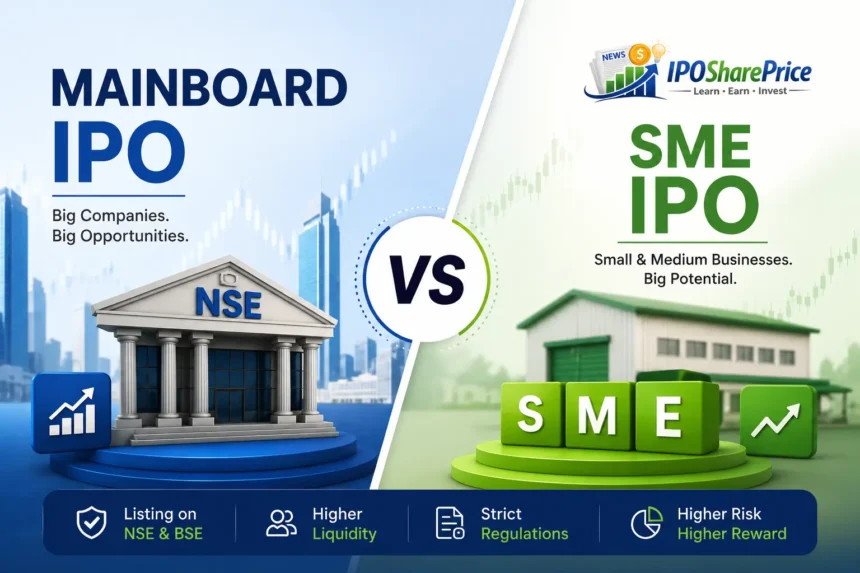
Mainboard vs SME IPO:
- Mainboard IPO: Larger companies, listed on NSE/BSE main board, stricter SEBI eligibility, minimum ₹10,000–₹15,000 retail application, more institutional participation
- SME IPO: Smaller companies, listed on NSE SME or BSE SME, lower eligibility requirements, higher minimum application (typically ₹1 lakh+), higher risk and volatility
Mainboard IPOs are generally safer for retail investors. SME IPOs offer potentially higher returns but significantly higher risk, lower liquidity, and less analyst coverage.
Introduction: Not All IPOs Are Equal
When you see “IPO” in the news, it could refer to two very different types of offerings. A ₹5,000 crore tech company going public is fundamentally different from a ₹50 crore textile manufacturer’s debut.
India’s capital markets have two separate platforms for IPOs: the main board (NSE/BSE) and the SME platform (NSE SME/BSE SME). Understanding the difference is essential — especially because SME IPOs carry significantly higher risk.
What is a Mainboard IPO?
A Mainboard IPO lists on the main board of NSE (National Stock Exchange) or BSE (Bombay Stock Exchange). These are typically larger, more established companies with proven revenue and profitability track records.
SEBI eligibility criteria for Mainboard IPO:
- Paid-up capital post-issue: Above ₹10 crore
- Net worth: Various requirements based on the route chosen (Track record route: 3 years of distributable profits; Net worth route: ₹1 crore net worth for 3 years)
- Minimum post-issue market cap: Typically above ₹25 crore
- SEBI ICDR (Issue of Capital and Disclosure Requirements) Regulations apply in full
What is an SME IPO?
An SME IPO lists on NSE SME (NSE Emerge) or BSE SME. These platforms were created by SEBI in 2012 to help Small and Medium Enterprises access public capital markets with reduced compliance requirements.
SEBI eligibility for SME IPO:
- Post-issue paid-up capital: Up to ₹25 crore (above this, company must list on main board)
- Net worth: ₹1 crore or above
- Track record: 3 years of operating history (with exceptions for certain types)
- No minimum profit requirement in most cases
Key Differences: Mainboard vs SME IPO
| Feature | Mainboard IPO | SME IPO |
| Listed on | NSE / BSE main board | NSE SME / BSE SME |
| Company size | Larger, more established | Smaller companies |
| Minimum application | ₹10,000–₹15,000 | ₹1,00,000+ |
| Market maker required | No | Yes (mandatory) |
| SEBI compliance | Full ICDR regulations | Lighter compliance |
| Institutional participation | High (QIBs, FIIs) | Very low |
| Analyst coverage | Good | Minimal |
| Liquidity post-listing | High | Often thin |
| GMP reliability | More reliable | Less reliable |
| Risk for retail investors | Moderate | High |
| Allotment process | Lottery (retail) / proportional (HNI) | Proportional for all |
SME IPO Minimum Application: Why It’s Higher
For SME IPOs, SEBI mandates a minimum application of ₹1 lakh (often higher — ₹1.2 lakh to ₹1.5 lakh depending on lot size and price). This is deliberately higher than Mainboard’s ₹10,000–₹15,000 threshold.
The rationale: SEBI recognizes that SME IPOs carry higher risk and wants to limit exposure to investors with at least ₹1 lakh of investable capital, implying some minimum financial sophistication.
Which Should You Apply For?
Apply for Mainboard IPOs if:
- You are a beginner or moderate-experience investor
- You want meaningful institutional validation (high QIB participation)
- You prefer better liquidity post-listing
- You want to invest smaller amounts (₹15,000 minimum)
Consider SME IPOs only if:
- You have experience evaluating small-cap fundamentals
- You can afford to invest ₹1 lakh+ at higher risk
- You have thoroughly read the DRHP and understand the business
- You accept that listing gains can be erratic and liquidity may be thin
- You never rely solely on GMP for SME IPOs — their grey market is easily manipulated
Frequently Asked Questions
Can SME IPO stocks graduate to the main board?
Yes. SEBI has a migration process for SME-listed companies that meet main board eligibility criteria. Several SME IPOs have successfully migrated to main boards after growing.
Is GMP reliable for SME IPOs?
Less so than for Mainboard IPOs. SME IPO GMP has been subject to manipulation, and several high-GMP SME IPOs have listed at or below issue price. Treat SME GMP with extra skepticism.
Do SME IPOs have the same ASBA process?
Yes. SME IPOs also use UPI and ASBA, though the minimum application amount is higher.