


AI Overview
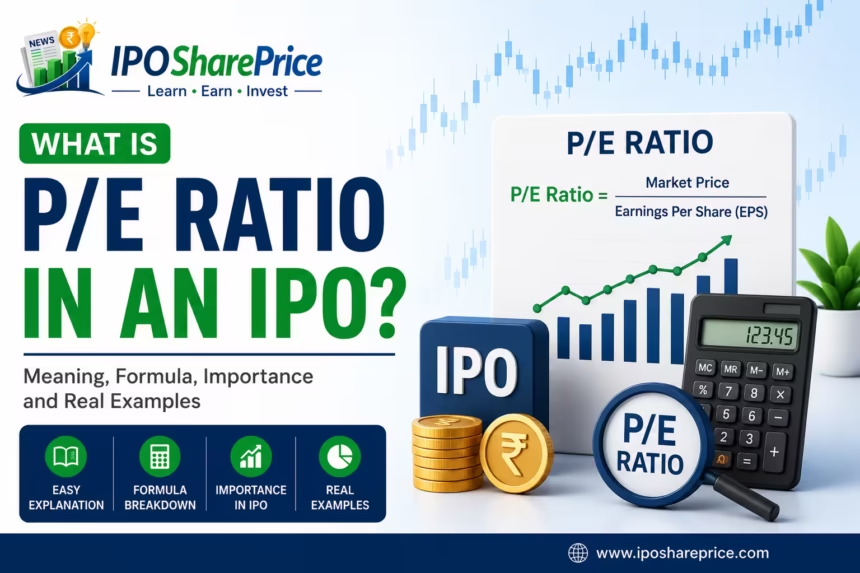
What is P/E ratio in IPO? P/E ratio (Price-to-Earnings ratio) measures how much investors are paying per rupee of company earnings. Formula: P/E = Issue Price per Share ÷ Earnings Per Share (EPS). A high P/E relative to industry peers suggests the IPO may be overvalued. A P/E in line with or below peers suggests reasonable valuation. P/E alone is not sufficient always combine with growth rate, margins, and sector context.
Introduction: The Most Common Valuation Tool for IPOs
Before applying for an IPO, one of the first questions to ask is: at this price, is this company cheap or expensive?
The P/E ratio is the quickest way to start answering that question. It is not perfect, and it should never be used alone but it is the universal first filter that investors and analysts apply when evaluating whether an IPO’s pricing is fair.
What is P/E Ratio?
P/E Ratio = Share Price ÷ Earnings Per Share (EPS)
- Share Price: The issue price (upper price band) of the IPO
- EPS (Earnings Per Share): Net profit ÷ Total shares outstanding (post-IPO)
Example:
- Issue price: ₹300
- Net profit (last year): ₹100 crore
- Total shares post-IPO: 10 crore
- EPS: ₹100 crore ÷ 10 crore = ₹10
- P/E ratio: ₹300 ÷ ₹10 = 30x
This means investors are paying 30 times the company’s annual earnings for each share.
How to Use P/E to Evaluate IPO Valuation
The P/E ratio of an IPO only has meaning when compared to something:
1. Industry/sector average P/E: The most important comparison. If the sector trades at an average P/E of 20x and the IPO is priced at 50x, it suggests overvaluation unless the IPO company has significantly better growth prospects or margins.
2. Listed peer P/E: Find 2–3 directly comparable listed companies. If Company A trades at 25x P/E and the IPO is priced at 40x P/E for a similar business, the IPO appears expensive.
3. Historical P/E range of the sector: Some sectors command premium P/E consistently (pharma, consumer staples). Others have lower P/E norms (metals, commodities). Context matters.
P/E Ratio Limitations for IPOs
Loss-making companies: P/E is meaningless if the company has negative earnings. For loss-making IPOs, analysts use alternative metrics: Price-to-Sales (P/S), EV/EBITDA, or forward P/E based on projected earnings.
Growth matters: A 40x P/E company growing revenue at 50% annually may actually be cheaper than a 20x P/E company growing at 5%. This is why the PEG ratio (P/E ÷ Growth Rate) is sometimes used alongside P/E.
One-year snapshot: P/E uses last year’s earnings. A company that had an exceptional year or a bad year will have a distorted P/E. Look at 3-year average EPS for a cleaner picture.
Adjusted vs reported earnings: Some companies include one-time gains or hide one-time losses in reported profit. Always look at operating profit (EBITDA) alongside reported P/E.
What is a Good P/E for an IPO?
There is no universal answer it depends entirely on the sector:
| Sector | Typical P/E Range (India 2026) |
| Banking / NBFC | 10–25x |
| IT / Technology | 25–50x |
| Pharma / Healthcare | 25–45x |
| Consumer Goods (FMCG) | 40–70x |
| Manufacturing / Industrials | 15–35x |
| Renewable Energy | 30–60x |
| E-commerce / New-Age Tech | Often negative (use P/S) |
An IPO priced at a P/E significantly above its sector range is at risk of post-listing correction. An IPO priced at or below the sector P/E with strong growth momentum often delivers better long-term returns.
Frequently Asked Questions
What does a high P/E mean for an IPO?
A high P/E relative to peers means investors are paying a significant premium for each rupee of earnings often because they expect high future growth. If that growth does not materialize, the stock can correct sharply post-listing.
Can a high P/E IPO still be a good investment?
Yes, if the growth rate justifies the premium. Amazon traded at seemingly absurd P/E ratios for years its growth rate made the valuation reasonable in hindsight. Apply the same logic: does the growth story justify the premium?
What P/E is too high for an IPO?
There is no absolute cutoff. But an IPO priced at 2–3x its sector average P/E without a compelling differentiated growth story warrants serious caution.