

AI Overview
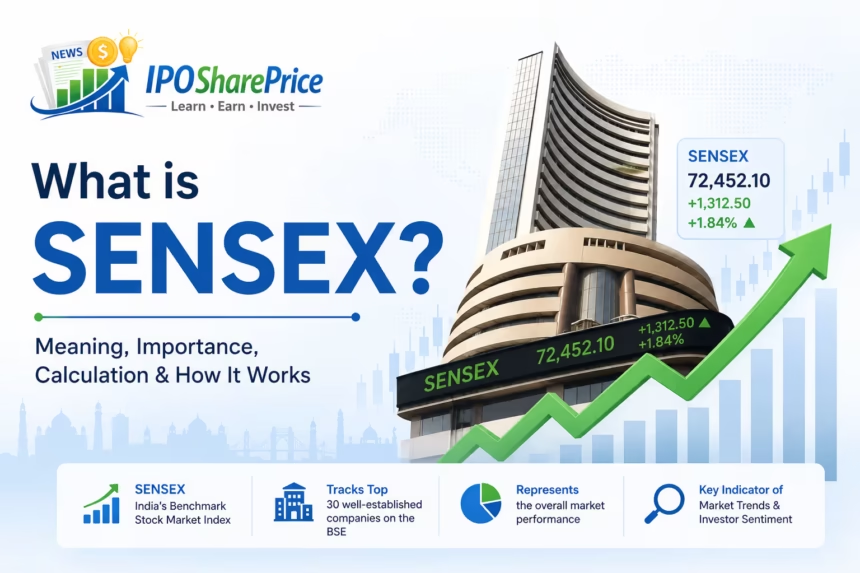
What is Sensex? Sensex (Sensitive Index) is India’s oldest stock market index, maintained by the Bombay Stock Exchange (BSE). It tracks 30 of India’s largest, most financially sound, and most actively traded companies listed on BSE. Sensex is calculated using free-float market capitalization methodology. Its base value is 100, set in 1978–79. When Sensex rises 500 points, it means the weighted value of these 30 companies has increased collectively.
Introduction: India’s Oldest Market Barometer
Before Nifty, before SEBI, before online trading there was Sensex. Launched in 1986 by the Bombay Stock Exchange, Sensex is the oldest stock market index in India and remains one of the most widely quoted financial numbers in the country.
Every evening, television anchors say “Sensex closed at X.” Every morning, newspapers lead with “Sensex fell 300 points.” But most people hearing these numbers do not fully understand what they represent, how they are calculated, or why they go up and down.
This guide gives you a complete understanding of Sensex its meaning, composition, calculation, and what it tells you as an investor.
What is Sensex? The Complete Definition
Sensex is the short form of Sensitive Index. It is BSE’s flagship benchmark index, tracking 30 of the largest and most liquid companies listed on the Bombay Stock Exchange.
The index was introduced on January 1, 1986, but its historical data was back-calculated to 1979. The base year is 1978–79, with a base value of 100. By 2026, Sensex has crossed 70,000 points meaning India’s top companies (as tracked through BSE) have collectively grown 700 times in value since the base period.
Sensex is officially maintained by Asia Index Private Limited, a joint venture between BSE and S&P Dow Jones Indices.
How is Sensex Calculated?
Sensex uses the free-float market capitalization weighted methodology the same method used by Nifty 50 and most global indices.
Free-float market cap = Share price × Number of shares available for public trading (excluding promoter holdings and strategic holdings that cannot be freely traded)
Companies with a higher free-float market cap have a larger weight in the index and therefore move Sensex more when their price changes.
The formula:
Sensex = (Current Free-Float Market Cap of 30 Companies / Base Market Cap) × Base Index Value (100)
The base market cap is the free-float market cap of all 30 companies on the base date.
Which Companies Are in Sensex?
The 30 Sensex companies are selected by BSE’s Index Committee based on criteria including free-float market cap, trading frequency, sector representation, and financial health. The composition is reviewed and rebalanced twice a year.
Key sectors represented in Sensex (2026):
| Sector | Representative Companies |
| Banking & Financial Services | HDFC Bank, ICICI Bank, SBI, Kotak Mahindra Bank, Axis Bank |
| Information Technology | Infosys, TCS, Wipro, HCL Technologies |
| Energy | Reliance Industries, ONGC, NTPC |
| Consumer Goods | HUL, ITC, Nestle India |
| Automobiles | Maruti Suzuki, Bajaj Auto, M&M |
| Pharmaceutical | Sun Pharma, Dr. Reddy’s |
| Conglomerate | Tata Consultancy Services (TCS), L&T |
Note: The exact composition changes with index rebalancing. Always check the current Sensex constituent list on BSE’s official website for the latest data.
What Does Sensex Up or Down 500 Points Mean?
This is one of the most commonly misunderstood aspects of stock market reporting.
A 500-point move in Sensex at 70,000 is a 0.71% change a relatively small daily movement.
A 500-point move in Sensex at 10,000 (where it was around 2004) would have been a 5% change a very significant single-day move.
The key lesson: always look at the percentage change, not just the points. The points figure only has context relative to the current index level.
Practical translation:
| Sensex Level | 500-Point Move | Percentage Change |
| 20,000 | 500 points | 2.5% |
| 50,000 | 500 points | 1.0% |
| 70,000 | 500 points | 0.71% |
For IPO investors, a 1% Sensex move on the listing day can shift the listing price by a meaningful margin. A 2%+ fall on listing day regularly drags IPO opening prices below GMP estimates.
Sensex vs Nifty 50: Key Differences
| Feature | Sensex | Nifty 50 |
| Exchange | BSE | NSE |
| Companies | 30 | 50 |
| Base Year | 1978–79 | 1995 |
| Base Value | 100 | 1,000 |
| Maintained By | Asia Index Pvt Ltd (BSE + S&P) | NSE Indices Limited |
| Calculation | Free-float market cap | Free-float market cap |
| Rebalancing | Semi-annual | Semi-annual |
Despite tracking different numbers of companies on different exchanges, Sensex and Nifty 50 move in very similar directions because they share most of India’s largest companies. On most trading days, if Sensex is up 0.5%, Nifty 50 will also be up roughly 0.4% to 0.6%.
See our NSE vs BSE guide for a full comparison of the two exchanges and their indices.
Why Does Sensex Go Up or Down?
Sensex reflects the collective market valuation of India’s 30 largest companies. Its daily movement is driven by:
- Domestic factors: RBI monetary policy decisions (interest rate changes), quarterly corporate earnings, government budget announcements, inflation data, and major news about Sensex-component companies.
- Global factors: US Federal Reserve policy, global crude oil prices (India is a major oil importer), US stock market movement (especially Nasdaq for IT stocks), FII (Foreign Institutional Investor) buying or selling activity.
- Sentiment factors: Election results, geopolitical events, global economic outlook, and broad risk-on/risk-off sentiment in global markets.
Sensex and IPO Investors
For IPO investors, Sensex matters in three specific ways:
- During subscription window: A rallying Sensex during an IPO’s subscription window boosts retail and HNI participation, driving up subscription multiples and GMP simultaneously.
- On listing day: The Sensex level and direction on listing morning strongly influences where the IPO opens. Many IPOs with strong fundamentals and high GMP still open at or near issue price when Sensex falls sharply on listing morning.
- For long-term IPO investors: Investors who hold IPO shares beyond listing day are exposed to broader market risk. A declining Sensex trend over months can drag even good IPO stocks below their issue price.
Frequently Asked Questions
What is the full form of Sensex?
Sensex stands for Sensitive Index. The “Sens” comes from Sensitive and “ex” from Index.
When was Sensex launched?
Officially on January 1, 1986, but historical data was computed back to 1979.
What is Sensex’s all-time high?
Sensex crossed 85,000 in 2024 and has been trading in the 70,000–80,000 range through 2025–2026. Check live data on BSE’s official website for the current figure.
What is Sensex’s base value?
100 points, representing the market cap of the 30 constituent companies in the base year 1978–79.
Can I invest in Sensex directly?
Not directly. You can invest in BSE Sensex index funds or ETFs (Sensex ETF) through any demat account that track the index passively.
Why does Sensex sometimes move differently from Nifty 50?
Since Sensex tracks 30 companies and Nifty 50 tracks 50, there can be short-term divergences if one of the non-overlapping companies moves sharply. But over any meaningful time period, both indices move together.
Is Sensex at 70,000 expensive or cheap?
Index level alone does not indicate valuation. Analysts compare the P/E ratio of Sensex to its historical average to assess whether the market is overvalued or undervalued. A high P/E relative to historical average suggests caution; a low P/E suggests value.
Summary
- Sensex is India’s oldest stock index, tracking 30 BSE-listed companies since 1986
- It uses free-float market cap methodology larger companies have more influence
- Base value is 100, set in 1978–79; it has since crossed 70,000+
- A 500-point move at 70,000 is less than 1% always check the percentage
- Sensex and Nifty 50 track different exchanges but move together in practice
- For IPO investors, Sensex direction on listing day significantly impacts opening prices